top of page
Research and Work

Molecular dynamics (MD) simulation is a computer simulation method for analyzing the physical movements of atoms and molecules. I have used MD to understand interesting interfacial phenomena, including the transport of fuel molecules across surfactant-covered interfaces, the slippage at fluid-fluid interfaces, and the adsorption of molecules on surfaces.
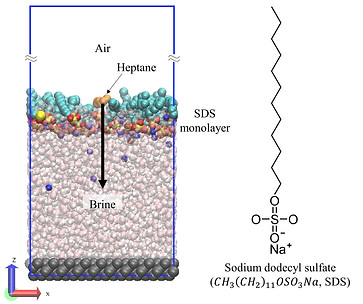
1. Transport of Heptane Molecules across SDS-Covered Water-Vapor Interfaces (2022 - 2023)
Molecular transport across liquid-vapor interfaces covered by surfactant monolayers plays a key role in applications such as fire suppression by foams. The molecular understanding of such transport, however, remains incomplete. This work uses molecular dynamics simulations to investigate the heptane transport across water-vapor interfaces populated with sodium dodecyl sulfate (SDS) surfactants. Heptane molecules’ potential of mean force (PMF) and local diffusivity profiles across SDS monolayers with different SDS surface excesses are calculated to obtain heptane’s transport resistance.
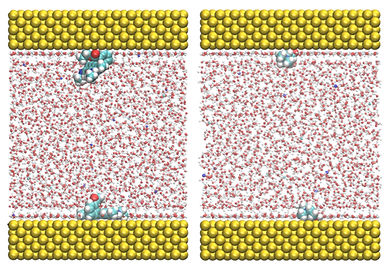
2. Adsorption of Rhodamine 6G and Choline on Gold Electrodes (2021 - 2022)
The adsorption of analyte molecules on nano-optoelectronics (e.g., a combined nanoantenna and nanoelectrode device) significantly affects the signal characteristics in Surface-Enhanced Raman Scattering (SERS) measurements. Understanding how different molecules adsorb on electrodes and their modulation of electrical potential help better interpret SERS measurements. This work investigates the adsorption of prototypical analyte molecules, Rhodamine 6G and choline, on gold electrodes with negative, neutral, and positive surface charges using molecular dynamics simulations.
3. Modulation of Slippage at Brine–Oil Interfaces by Surfactants (2021 - 2022)
Fluid transport involving brine–oil interfaces plays an important role in applications including enhanced oil recovery and oil-brine separation and can be affected markedly by the slippage at these interfaces. The slippage at brine–oil interfaces, however, is not well understood, especially in the presence of surfactants, which are ubiquitous in natural and engineering systems. Here, we report molecular dynamics studies of the slippage at brine–decane interfaces in the presence of two surfactants, nonylphenol and phenol.

bottom of page